Send notifications to admin users based on some Workspace activities
BeantwoordHi,
I'm working on configuring a chain to send notifications to admin users based on specific Workspace activities, and also log those activities into a spreadsheet. However, I'm currently stuck on the first part: retrieving the full list of activities from a Workspace.
Right now, I'm only getting 50 records, even though I know there are more. I'm not sure how to fetch the complete list. Additionally, when I try to write the data to a spreadsheet or table, I only get the last result instead of the full dataset.
I followed a similar article: Retrieve a list of activities for an organization API – Support Center but it didn’t fully resolve my issue.
Any guidance on how to retrieve all activity records and write them properly to a spreadsheet - or suggestions for alternative approaches - would be greatly appreciated.
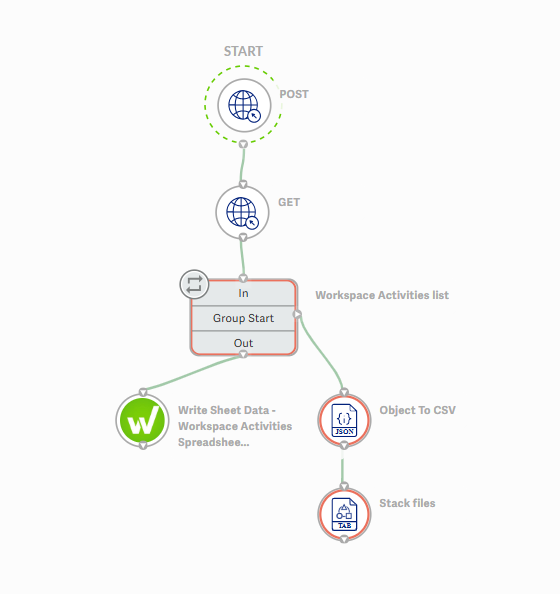
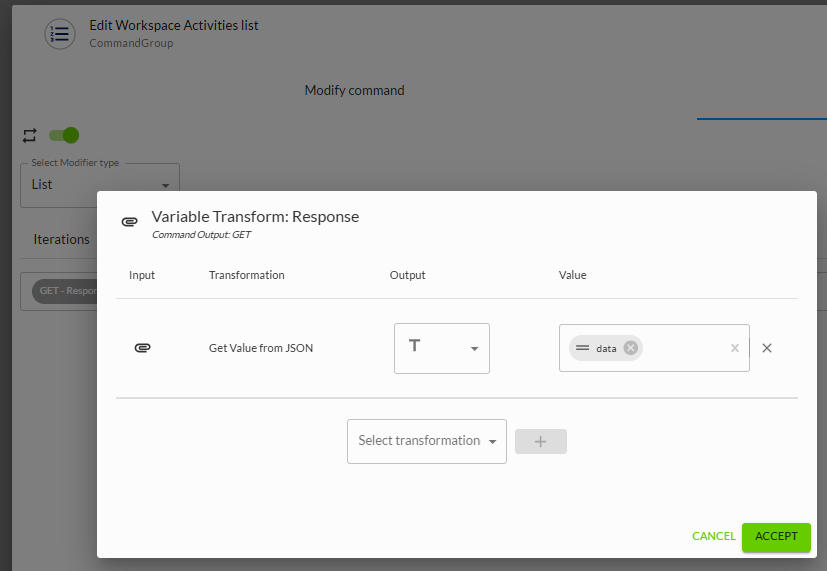
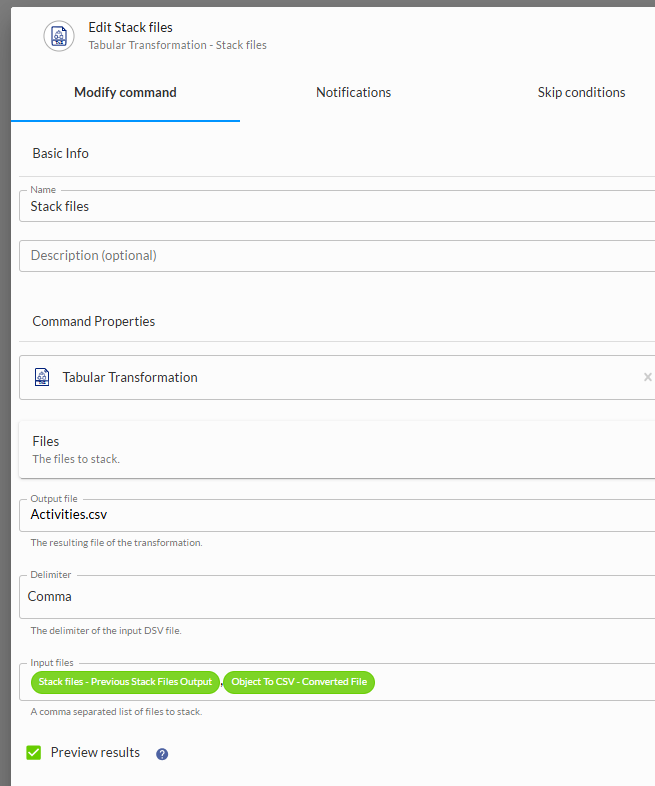
-

Hi Lorena Rojas Thanks for reaching out! I'm happy to try and help. You will need to check if the 50 record limit is part of the API you are querying. If it is, you would need to do a repetitive query, adding the results of each query to a table until they have all of the results. Please let us know if this doesn't help and I can connect with another expert on the team. Have a great day! 😊
0
Hi Lorena Rojas,
The Retrieve a list of activities for a workspace endpoint will return pages of results. If there is more than one page, you can call the next page via the value in @nextLink. The logic of your chain would be to have a Group Node that repeats until there is not a @nextLink value. Within the Group Node, call a GET request to pull the current page then stack the results. This continues until all pages have been retrieved. Move to the Out of your Group Node and you can then process the full result of the stacked files.
Thanks,
Jeff0
Hi Brooke Mortvedt, Jeff Hickey,
Thank you both for your support.
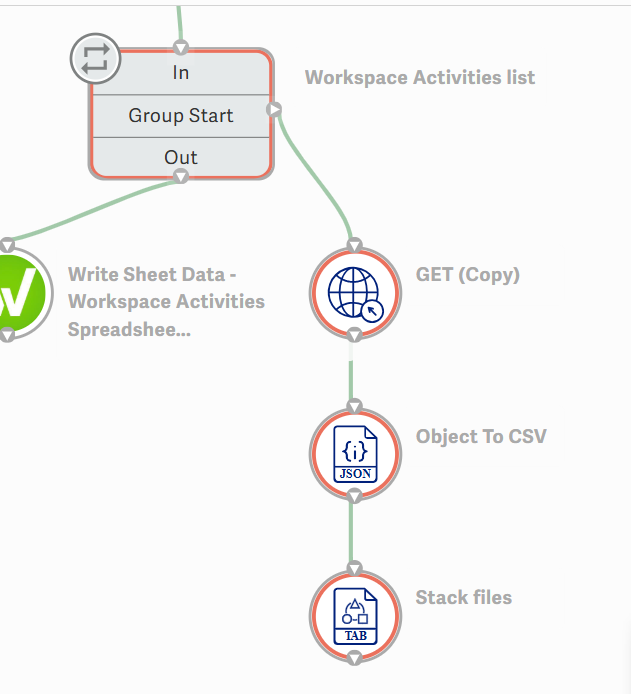
I’ve implemented the suggested changes: a Group Node that repeats until the
@nextLinkvalue is blank, and a GET request inside the Group Node to retrieve the current page. However, I now have a few questions:- Should the GET request inside the Group Node use the output from the previous GET request? which one?
- Is it correct to manage pagination using the iteration index?
- Currently, the Object to CSV command returns blank results. I suspect this is because it needs a prior iteration command to correctly read the page values. However, since nesting one Group Node inside another isn’t allowed, how can I work around this limitation?
- Additionally, I’d like to filter the first GET request using
datetime = System.DateTime, but the chain doesn’t seem to recognize the current format. What kind of transformation should be applied to make the datetime compatible with the request?
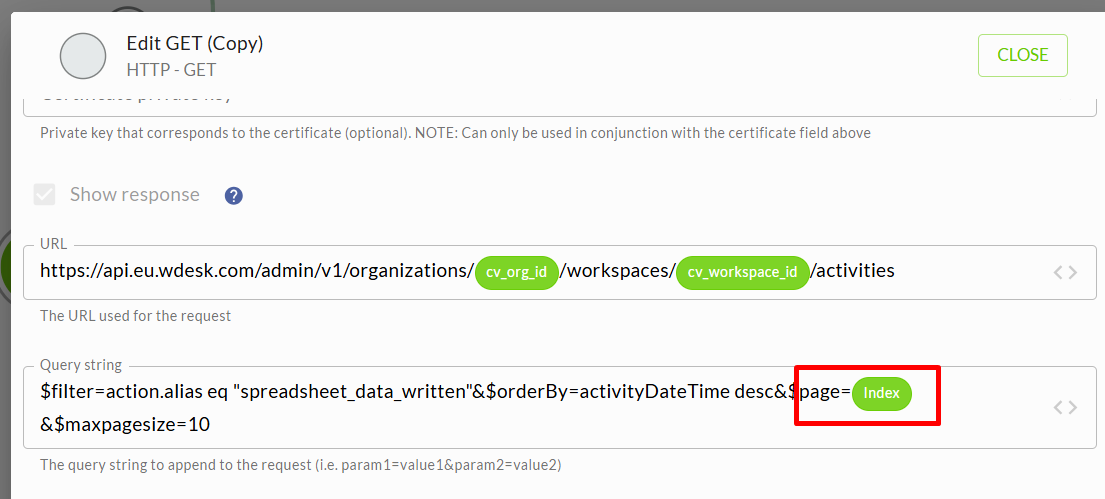
Thanks,
Lorena.
0
Hi Lorena Rojas,
- You only need the GET request inside of your Group because you will need to iterate at least once. If there are more pages, use the @nextLink path for your next GET call, and repeat until done. You don't need to pass a $page parameter, since the @nextLink is the path to the next page
- Use @nextLink value to page through results
- The command to convert to csv will depend on the data that you ultimately want since there are both arrays and objects in the response payload. I recommend using Handlebars to build your output. Handlebars also has the added advantage of being able to retrieve the prior iteration's Handlebars output which means you wouldn't have to use Stack Files if you choose to go this route
- Here is an example of filtering by activity time for actives that happened prior to 10/31/2025: <url>?$filter=activityDateTime lt 2025-10-31T00:00:00Z
0U moet u aanmelden om een opmerking te plaatsen.
Opmerkingen
4 opmerkingen