Ninth Circuit Ruling on California Climate Disclosure Laws (SB 253 and SB 261)
On November 9, 2026, the Ninth Circuit Court delivered its long awaited rulings on the Chambers’ of Commerce injunction requests on California’s Climate Corporate Data Accountability Act (SB 253) and Climate Related FInancial Risk Act (SB 261). The Court denied the injunction against SB 253's Scope 1 and Scope 2 reporting, so those requirements remain in force. It granted injunctions against SB 253's Scope 3 requirement and against SB 261 in its entirety, finding both likely unconstitutional under the First Amendment.
- ➢ Still required: Scope 1 and Scope 2 emissions reporting under SB 253, including the first filing due November 10, 2026.
- ➢ Blocked (likely unconstitutional): SB 253 Scope 3 reporting and SB 261 climate-related financial risk reports.
- ➢ Not final: this is a ruling on a preliminary injunction, so the court assessed likely outcomes rather than issuing a final decision. Further review is possible and companies should continue to monitor both laws.
Ruling at a glance
The court split the two laws three ways. Scope 1 and 2 reporting under SB 253 stays fully in force, while scope 3 requirements and SB 261 climate risk reports are in jeopardy on grounds of unconstitutional compelled speech
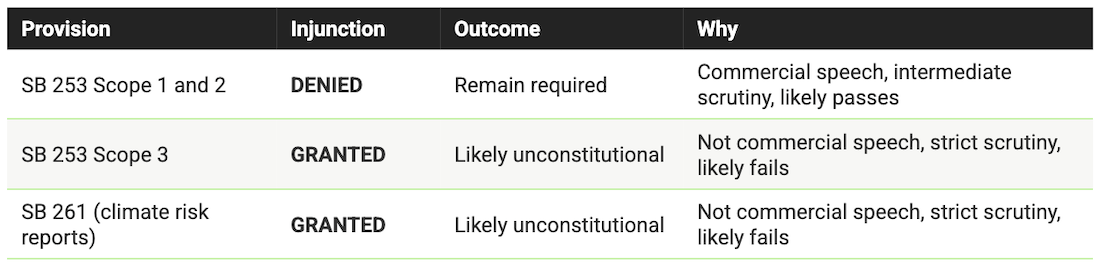
The case is U.S. Chamber of Commerce v. Sanchez, No. 25-5327. "Intermediate" and "strict" scrutiny are the court's two levels of First Amendment review. Strict scrutiny is much harder for a law to survive. "Commercial speech" means speech tied to commercial transactions, which gets a more lenient review.
What the ruling does not decide
- ➢ It is preliminary. The court judged who is likely to win, not the final merits. Rehearing before a larger panel of the court, or Supreme Court review, remains possible.
- ➢ Scope 3 severability is open. The district court must decide whether Scope 3 can be removed from SB 253 without affecting the rest.
- ➢ Order details are unclear. The opinion reverses the lower court's denial but does not spell out the scope of the injunction. Whether it protects all companies or only the plaintiffs' members needs to be confirmed.
- ➢ Facial challenge only. The court assessed the laws as written. Challenges by individual companies about how the laws apply to them are not decided.
Takeaways
Scope 1 & 2 is still required while Scope 3 is likely blocked
Those preparing California filings for Scope 1 and 2 can proceed without legal caveats, with the first due November 10, 2026. The block on Scope 3, intended for 2027 disclosures, is preliminary, assessing likely outcomes rather than a final decision, which also leaves it open for questions regarding severability and further appeals.
Critical context beyond California’s mandate
California is only part of the regulatory landscape, and other global regimes, including EU’s CSRD, and country adoptions of ISSB reporting, in addition to market actors such as investors, lenders, and customers, continue to drive Scope 3 and climate-risk disclosure work. Establishing repeatable, defensible emissions inventories and climate risk assessments best positions organizations to meet both market and regulatory requirements, while also providing critical business insights towards long term planning and capital investment.
Zaloguj się, aby dodać komentarz.
Komentarze
Komentarze: 0